

NEW TRAINING: EtCS 2020

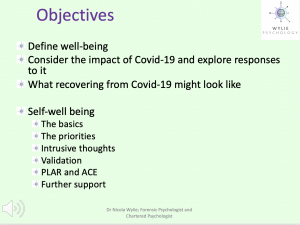
Hello everyone in the EtCS forum – if you open the ‘downloads’ tab under the main ‘Training’ tab from the drop down list you will see the prompt to enter the password for my 2020 Training on Well-being.  Once you have done this you will be able to open and follow the Powerpoint designed for you.  I hope you enjoy it; to prompt you please see the below slide of ‘Objectives’.  If you don’t have the password you can contact me via email or got directly to EtCS to request it.  
Flexible Training
One hour, half day or full day sessions

Below is a list of topics to indicate the range of issues that can be serviced.
Please email or call if you have any specific requests and I'll be delighted to discuss ideas with you. T: 07801 966759

EMAIL ME

Becoming unable to care

  • Definitions of blocked care and compassion fatigue
  • typologies within each definition
  • phases of compassion fatigue 
  • a real time cycle of compassion fatigue 
  • what it means to be ‘at risk’ and how to spot becoming unable to care 
  • case examples of ‘at risk’ people 
  • strategies for the self
  • strategies for supervision 

Increase awareness of how trauma impacts individuals

  • Explore facts and figures
  • Increase awareness of mental health definitions
  • To understand the function of behaviour Dto understand the potential impact of trauma
  • Increase awareness of what trauma-linked behaviours can include

Positive behaviour support: from an attachment perspective

  • Definition of positive behaviour support (PBS)
  • Examples of PBS in practice
  • Creating a support plan for a young person
  • Exploration of own attachment style
  • How to manage our own attachment when implementing PBS

Putting knowledge into practice

  • Accountability and Responsibility 
  • What do we know?
  • Getting it right: informed practice 
  • Disposals and community alternatives 
  • Systemic approaches 

Working with self-harm and suicide

  • To understand the facts and statistics 
  • Increase awareness of why young people self-harm or feel suicidal 
  • Consider strategies to reduce the risks

Working with people who display high risk

  • What is risk?
  • What informs risk assessment and management?
  • Risk and protective factors 
  • Informed practice 

Development, attachment and mental health: a perspective of interventions in residential childcare

  • To understand the developing brain
  • To understand how attachment patterns form and what they mean
  • Increase awareness current mental health statistics
  • Explore strategies that help children and young people in need

Child sexual exploitation

  • Terminology and definitions in relation to CSE 
  • The key vulnerability factors, risk indicators and spectrum of experiences in relation to CSE 
  • Strategies to increase confidence in direct work with children and young people regarding CSE 
  • Recognise the importance of information-sharing and multi-agency partnership in responding to children and young people

Formulation and scenario planning

  • Formulation definition and phases to a good formulation
  • Scenario planning and how to make it relevant 
  • Proportionality 

Risk assessment

  • Increase awareness of what risk can be
  • To understand how to assess risk
  • To understand how to manage risk

Developing resilience

  • Keeping staff groups resilient
  • Promoting resilience in others

Continued Professional Development

Dr Nicola Wylie delivers a range of workshops and training across the mental health and wellbeing agenda. These are delivered to organisations and their employees, teaching staff, children, young people and families and those who wish to increase their knowledge and enhance their skills in Mental Health.